In the roughly 50 public conferences our team delivers each year, one question comes up again and again: which economic sectors are most at risk of major disruption over the next few years? Our view is clear: the financial and quaternary sectors could be among those most exposed to significant contraction over the next decade, not because of ideology, but because of growing physical, energy, and economic constraints.
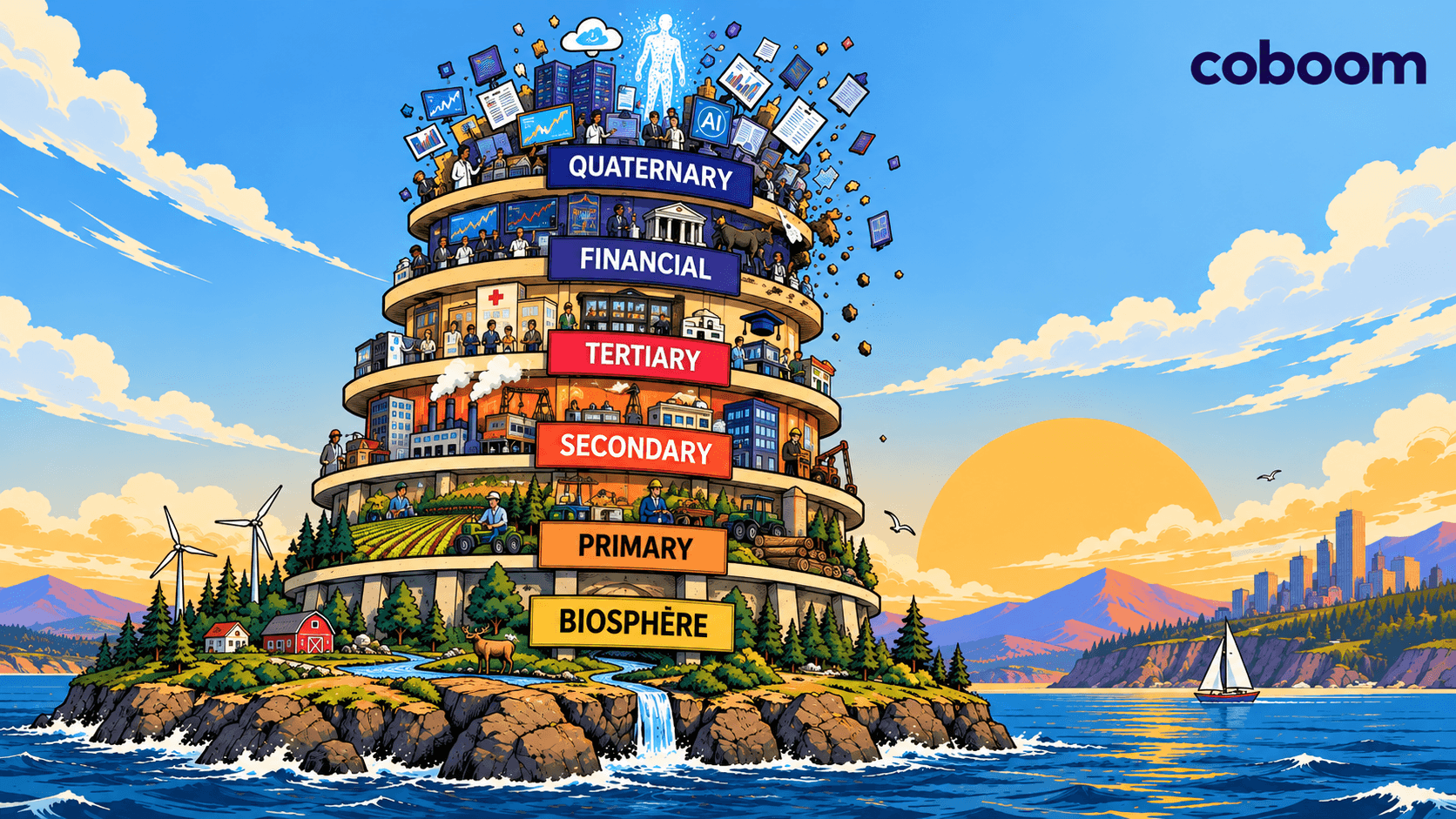
Our economy increasingly resembles a Tower of Babel. The higher we climb, the farther we move from activities directly tied to matter, energy, and essential needs, while adding more financial, digital, administrative, and intellectual layers that remain completely dependent on that material foundation.
The financial sector is not the real economy itself. It is the layer that finances, insures, and values the rest of economic activity through credit, debt, markets, insurance, and investment. It plays an essential role when it supports productive activity, but it becomes more fragile when it grows persistently faster than the material economy it is meant to support and converts an increasing share of the future into promises of returns or repayment.
The quaternary sector includes much of the knowledge and optimization economy: digital technologies, data, artificial intelligence, research, engineering, planning, consulting, and platforms. It creates substantial value when it helps us do more with less, but it also becomes vulnerable when it expands as if energy, natural resources, and the physical capacity required to sustain it were unlimited.
In a world where energy, resources, ecological stability, and productive capacity are becoming increasingly constrained, every part of the economy cannot keep growing at the same time. Trade-offs become more important, bringing the economy back toward its fundamental functions: feeding, housing, clothing, caring for, educating, transporting, and providing a sufficient level of collective security.
At the base of the economy lies the biosphere: soils, water, forests, energy resources, and a sufficiently stable climate. That foundation is under growing pressure. Access to some strategic resources is becoming less certain, the climate is destabilizing, and several planetary boundaries have already been exceeded, which means the economy will increasingly have to operate within constraints that cannot simply be negotiated away.
The primary sector, which provides food, energy, and raw materials, is therefore becoming strategic again. The secondary sector, which transforms those resources into goods, may need to refocus more heavily on essential needs and on shorter, more robust value chains. The tertiary sector may become increasingly divided between services directly tied to fundamental needs and those whose value depends more heavily on an economy of abundance.
At the top of the tower sit finance and much of the quaternary sector. We can create more credit, generate more data, and deploy increasingly powerful AI systems, but neither money nor AI can produce unlimited energy, raw materials, freshwater, or ecological stability.
The higher we climb in this economic tower, the easier it becomes to lose sight of the matter, energy, and natural systems that support it, while financial and intellectual models become increasingly abstract. Yet every level remains completely dependent on the levels below it.
We can build highly sophisticated economic models, multiply digital innovations, and imagine ever more ambitious technological solutions, but one reality remains: the economy is embedded in the physical world. The laws of physics will ultimately determine what our economic models can and cannot sustain.
For us, the strategic question is therefore no longer simply which sectors will grow, but which ones will remain genuinely useful, viable, and robust in a more constrained world.