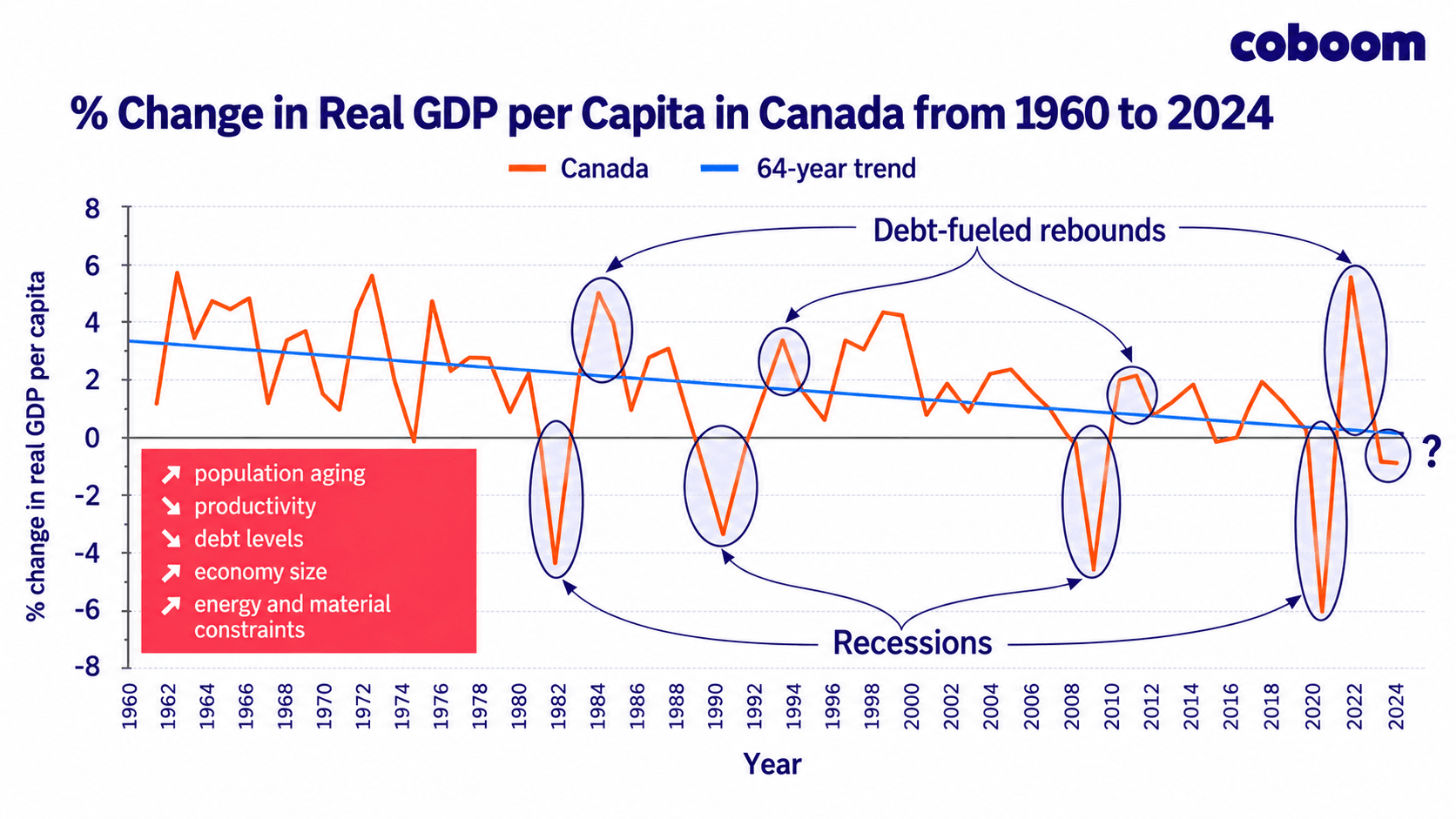
Since the 1960s, growth in Canada’s real GDP per capita has slowed markedly from one period to the next. It averaged 3.1% per year between 1961 and 1979, then 1.5% between 1980 and 1999, and only 1.1% between 2000 and 2019. More recently, real GDP per capita declined by 1.3% in 2023 and 1.4% in 2024, before increasing by roughly 0.6% in 2025.
This long-term trend points to a fundamental reality: the larger an economy becomes, the harder it is to keep expanding at the same pace. More infrastructure must be maintained, more complexity must be managed, more resources must be mobilized, and increasingly difficult and costly deposits must be exploited, all while environmental and social pressures continue to rise.
For decades, we have tried to offset these constraints through debt, financialization, speculation, overconsumption, and immense faith in technology’s ability to push limits further out. These mechanisms can extend the trajectory for a time, but economic activity ultimately remains dependent on energy, materials, and the capacity of ecosystems to absorb our waste and pollution.
For B2C companies, the impact is direct. In Quebec, household consumption accounts for close to 60% of real GDP. As per capita wealth grows more slowly and inequality increases, households become more selective in their spending, competition intensifies, and business growth depends increasingly on taking market share from competitors rather than benefiting from an expanding market.
The same dynamic spreads to B2B companies. Many of them serve businesses that sell directly to consumers, and when those customers see slower sales, they cut spending, postpone investments, and renegotiate with suppliers. Slower growth therefore works its way through much of the value chain.
Governments face the same pressure. An economy that generates less additional wealth per person creates less fiscal room at the same time as healthcare, infrastructure, and public-service needs continue to grow. New taxes, fees, and charges help finance part of those needs, while also putting additional pressure on disposable income and consumption.
Innovation will play a major role in this transition. It can improve efficiency, reduce certain resource requirements, and push some constraints further out, but it will always operate within the laws of physics and the real carrying capacity of ecosystems.
The most important innovations of the 21st century will therefore also be social, economic, and organizational. They will need to help companies, municipalities, and governments meet essential needs with fewer resources, tighter constraints, and much lower growth than the rates experienced during the 20th century.
The strategic challenge now is to learn how to create value, maintain quality of life, and build more robust companies and communities in a world where sustained per capita growth is becoming increasingly difficult to achieve.