The economic system no longer simply responds to our real needs. It constantly manufactures new ones to sell ever more superficial, often useless products and services, then presents this headlong rush as progress and innovation. The entire machine feeds on manufactured dissatisfaction: marketing creates it, credit finances it, planned obsolescence accelerates replacement, and social status turns overconsumption into a permanent competition staged on social media.
Our essential needs are first individual and material. Food, housing, clothing, healthcare, mobility, and safety are necessary to live with dignity. But a human life is about much more than material survival. We also have equally fundamental immaterial needs: affection, belonging, rest, understanding, participation, autonomy, identity, creativity, and meaning. Consumer products cannot satisfy them.
We also need to distinguish needs from the means we choose to satisfy them. The need for mobility does not require owning an SUV, the need for recognition does not require a luxury watch, and the need to communicate does not require replacing a smartphone every two years.
Our needs are also collective. Clean water, schools, hospitals, infrastructure, justice, public spaces, and functioning ecosystems cannot be guaranteed by piling up individual choices at the shopping mall.
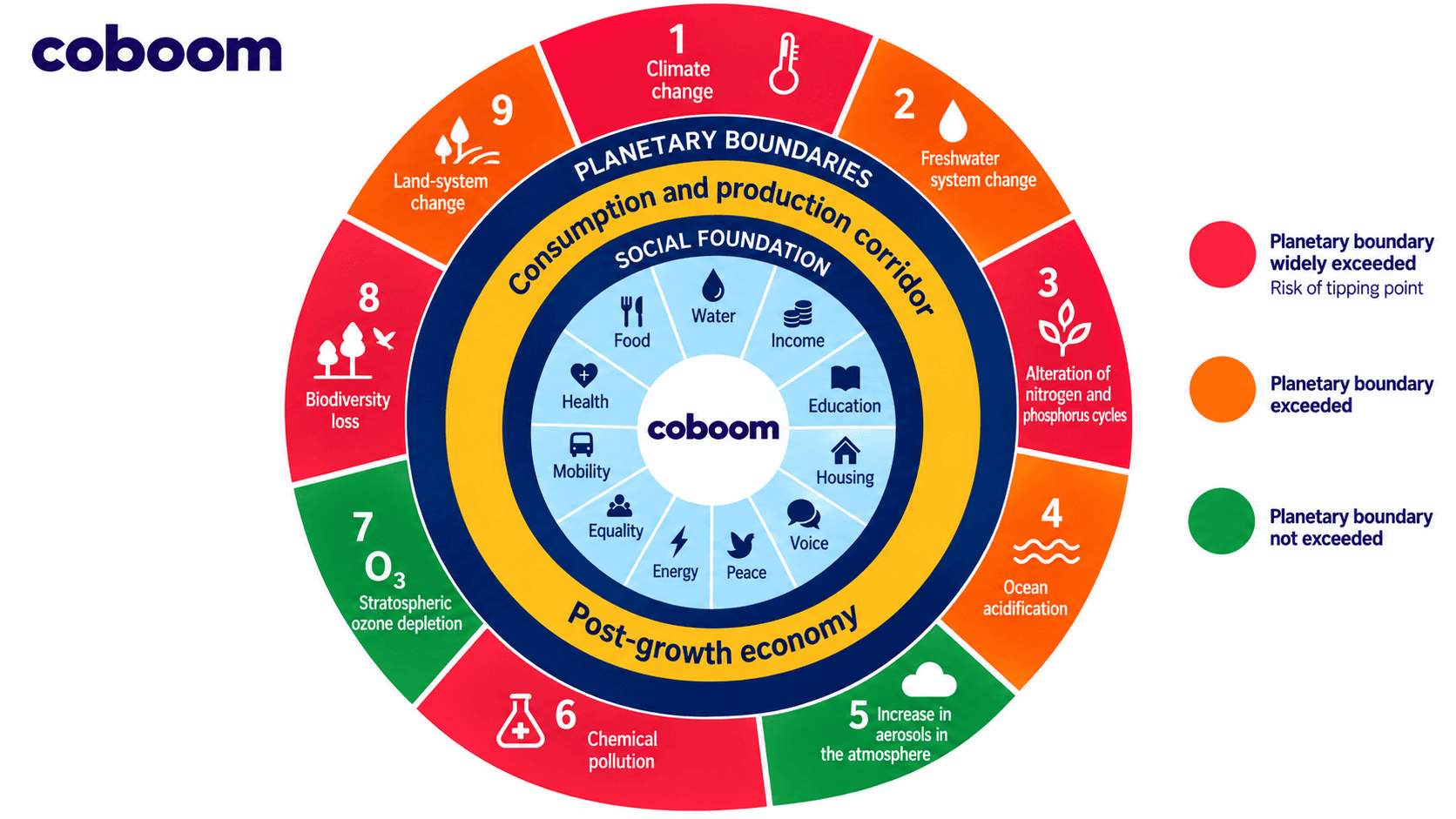
In 2012, British economist Kate Raworth introduced the concept of Doughnut Economics. It describes a safe space between a social foundation, below which essential human needs are not met, and an ecological ceiling, beyond which planetary boundaries are breached. She later popularized the model in her 2017 book.
In 2014, Swiss philosopher Antonietta Di Giulio and German political scientist Doris Fuchs applied a similar logic to individual consumption. The consumption corridor establishes a minimum level required to live with dignity, while also defining a maximum beyond which our consumption starts undermining other people’s ability to meet their own needs.
Between that social floor and ecological ceiling lies a vast space for freedom. The corridor does not prescribe one uniform way of living. It simply reminds us that a freedom that destroys the conditions required for others to live is not freedom at all. It is predatory privilege.
We need to stop confusing growth with progress. Companies, organizations, and municipalities need to stop chasing growth until it makes them more fragile. The priority lies elsewhere: becoming more robust and meeting real needs with fewer natural resources, less energy, less pollution, less debt, and fewer bullshit jobs.