The rapid and forced transformation of the economy will create many zombies by 2040: sectors, products, and services whose decline will become inevitable, yet into which we will keep pouring capital, infrastructure, and public money as if their future were guaranteed.
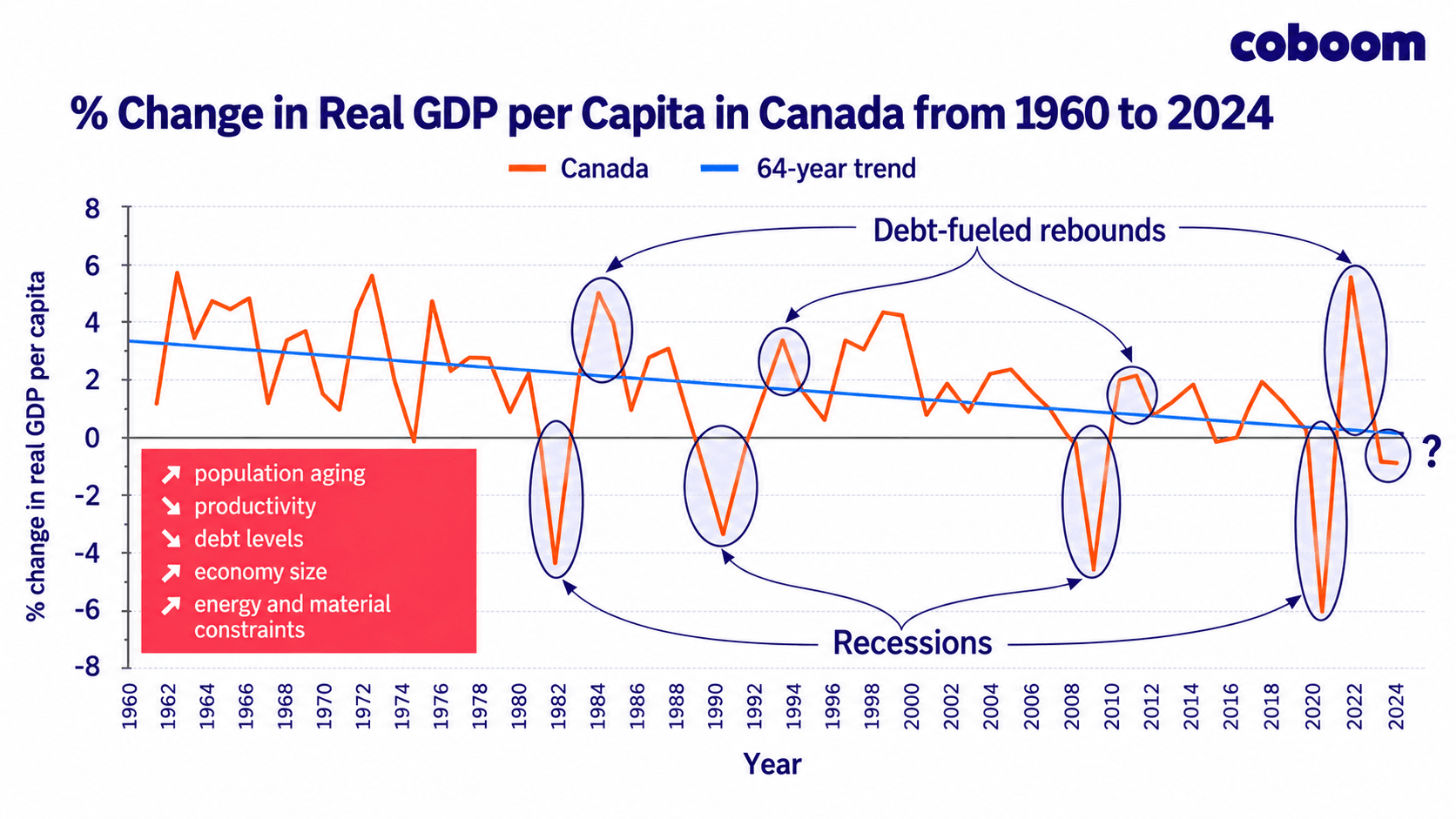
The constraints are already piling up: the structural slowdown in economic growth since the 1970s, public and private over-indebtedness, structural inflation, growing scarcity of energy and natural resources, job destruction driven by artificial intelligence, the coming deployment of humanoid robots, and the multiplication of geopolitical conflicts. Our economy is entering a more constrained world while many strategies are still being designed for a world of abundance.
Many industries and companies still project future growth based on assumptions that look more like acts of faith than strategy. They simply extend yesterday’s curves into the future, assuming that energy, materials, financing, consumers, and geopolitical stability will always be there.
Take the automotive industry. Its electrification assumes that the global economy will keep growing by roughly 3% a year, that the global vehicle fleet will continue expanding, that billions of vehicles can be replaced by electric vehicles by 2050, that the required metals and materials will remain available in sufficient quantities at affordable prices, and that a prosperous middle class will still be able and willing to buy individually owned vehicles.
Yet 3% annual economic growth means the global economy doubles in roughly 24 years. By 2050, we would therefore be trying to operate an economy almost twice as large on the same planet, with the same geological stocks and ecosystems that are already deeply degraded.
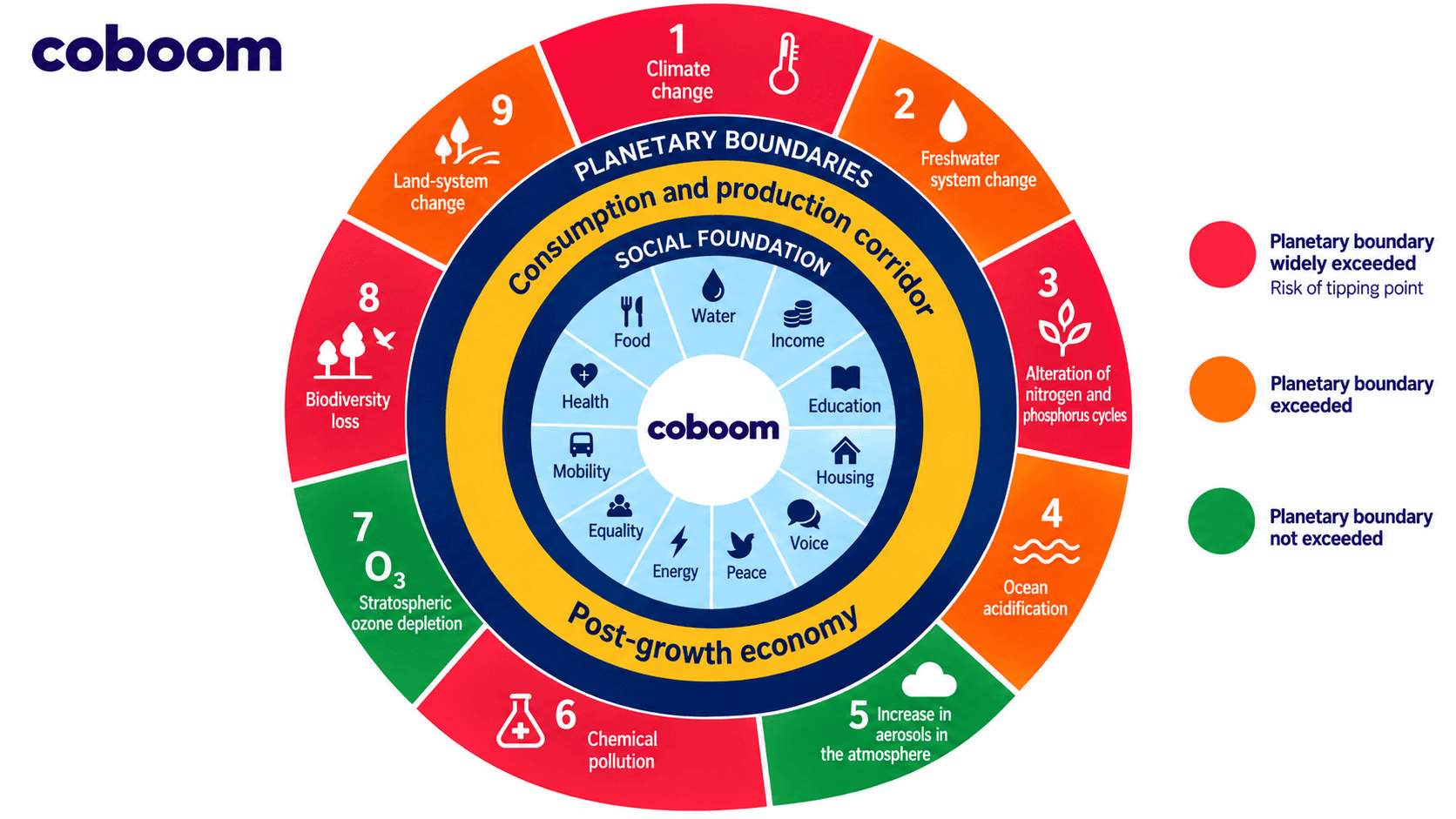
An economy twice as large is not virtual. It requires more energy, metals, minerals, infrastructure, transportation, and ecological capacity to absorb our impacts, even though seven of the nine planetary boundaries have already been breached.
Technology does not make this material reality disappear. It allows us to extract faster, produce more, expand consumption, and increase economic complexity, which in turn drives greater energy, material, and financial requirements.
Efficiency gains then fuel additional consumption. This is the Jevons paradox applied to an economy obsessed with growth.
In a metacrisis where physical, economic, social, and geopolitical constraints reinforce one another, continuing to build strategies on these assumptions amounts to blindness. A robust strategy begins by challenging precisely the assumptions everyone else prefers to take for granted.
At Coboom, we use a very simple test with business leaders and public decision-makers: would you invest your home, your savings, and your retirement fund based on these assumptions? If you would not risk your own wealth, the same level of scrutiny should apply when the money being invested belongs to taxpayers.
The Northvolt fiasco in Quebec illustrates this logic. Hundreds of millions of dollars were committed to a battery-market growth trajectory presented as nearly certain, while massive production capacity was being built elsewhere in the world and economic, material, and commercial constraints were already accumulating.
Financial engineering can delay the moment of truth, but it cannot change material requirements or physical limits. When a market, technology, or business model depends on a stack of fragile assumptions, sophisticated financing does not turn fragility into robustness.
The same assumptions are currently driving another industry that we consider the automotive sector’s twin. It too depends on affluent customers, mass individual mobility, abundant energy, and massive infrastructure, and it is already facing jet-fuel pressures that will return as oil production approaches its ceiling.
You have probably guessed which industry we mean. The next zombie may already be taking off.