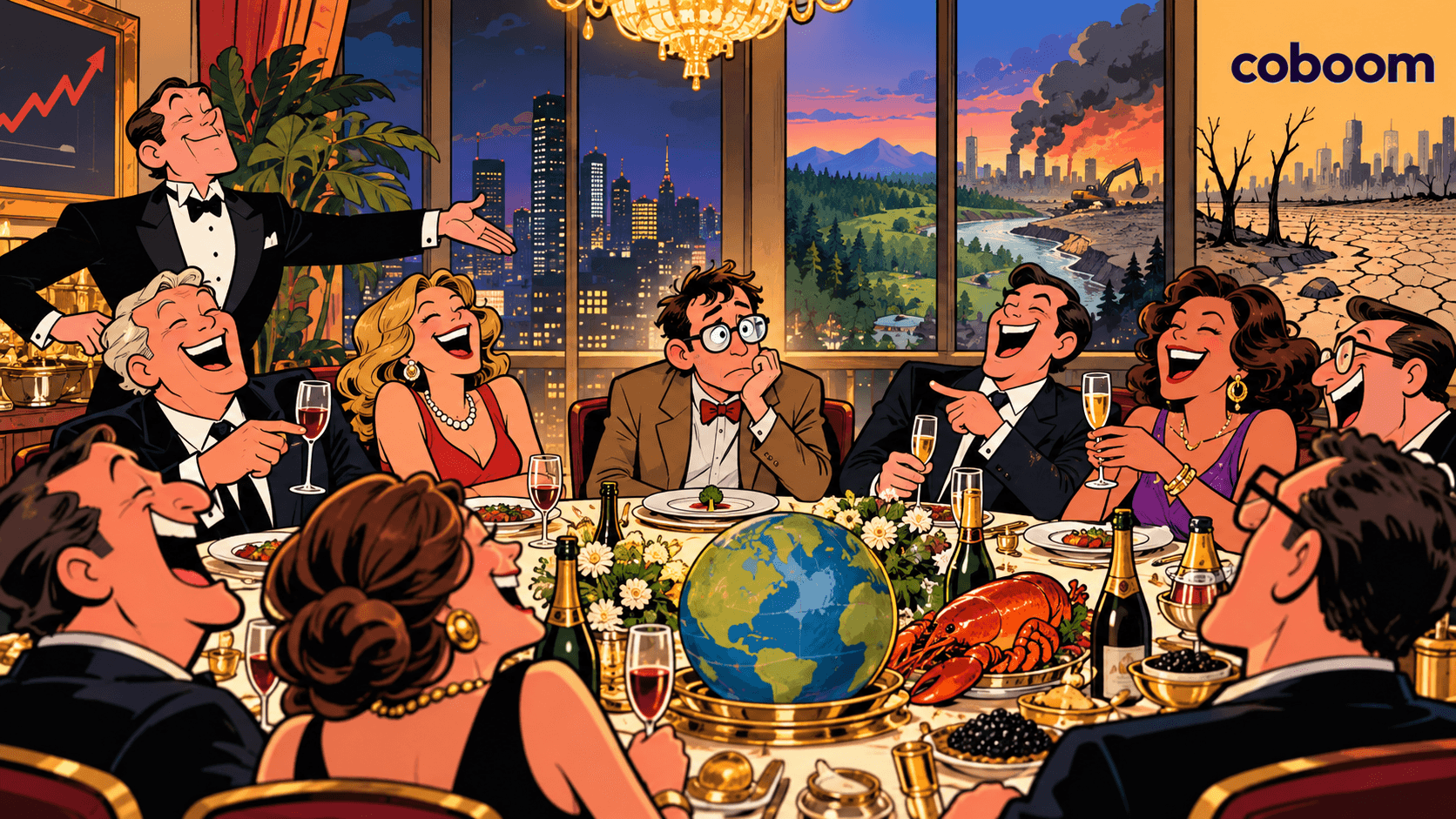
Last week, we compared the economy to a Tower of Babel. This week, we are proposing a more human analogy, inspired by the French film The Dinner Game. In that dinner, no one thinks they are the ridiculous one, and that is precisely what makes the situation so unsettling.
Let’s go back to the original meaning of the word economy. It comes from the Greek oikonomía: oikos, meaning house, and nomos, meaning rule or management. At its core, economics is about managing the household well: organizing limited resources to meet real needs and sustain that household over time. It was never meant to exhaust the house or weaken it to the point of collapse.
Our modern economy has drifted far from that logic. It continues to pursue permanent growth in a materially finite world, while behaving as though energy, natural resources, ecosystems, and human capacity were infinitely expandable.
To justify that race forward, we have long relied on the idea that wealth creation would eventually benefit society as a whole. In practice, when wealth becomes increasingly concentrated at the top, it does not circulate in the same way. It accumulates in the upper levels of the economic tower while the social, ecological, and material foundations below become more fragile.
Collectively, we begin to resemble the characters in The Dinner Game, invited to a banquet whose rules were designed by a very small part of society. We run faster, optimize more, produce more, and measure more, while increasingly feeling that we are standing still.
The paradox is becoming harder to ignore. We promise more collective progress, yet many social and environmental indicators tell a different story: loss of meaning, constant pressure, economic insecurity, rising food bank use, burnout, and accelerating ecological degradation. The high levels of anxiety and distress observed among younger generations also deserve to be understood as symptoms of an economic system that demands ever more individual adaptation to an environment that has itself become unstable.
Over time, we have reversed the logic. Human ingenuity, our ability to understand, imagine, organize, and create, is increasingly being put at the service of the economy rather than the economy serving people. Nature becomes an adjustment variable, living systems become inventory, and people become resources to optimize. Many management structures are still deeply shaped by this worldview inherited from Taylorism and the scientific division of labor.
The rapid development of artificial intelligence could accelerate this dynamic even further. After organizing human labor around industrial machines, we now risk organizing a growing share of knowledge work around digital machines, to the point where we may need to ask whether technology still serves human needs or whether we are gradually adapting our lives to the needs of the technological system.
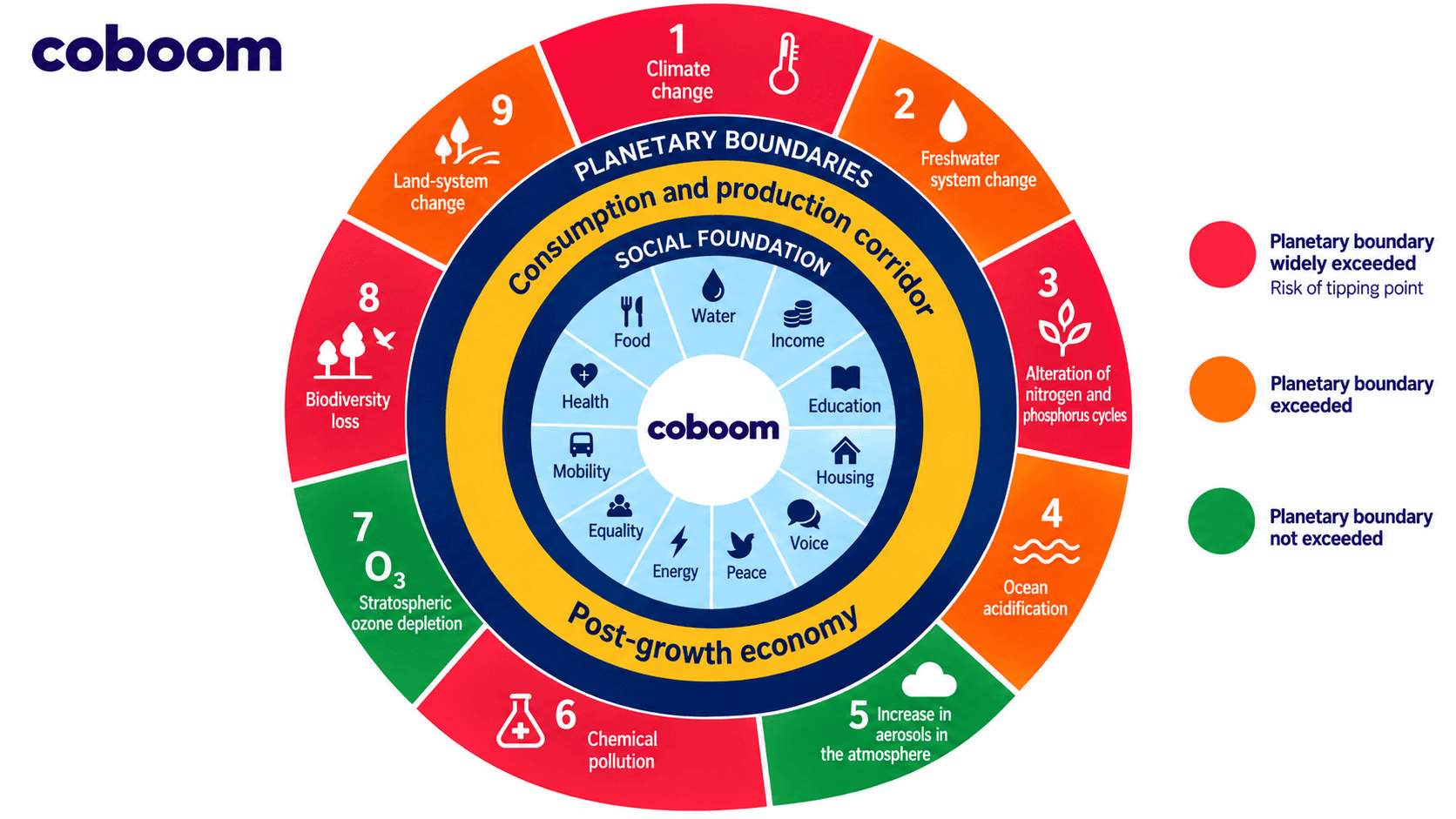
For us, the economy needs to recover its original purpose: enabling people to meet their needs sustainably within the limits of our shared home. That home is the biosphere, and no economic theory, financial market, or artificial intelligence can escape its limits indefinitely.
The question is therefore no longer simply how to grow. It is why we want to grow, who benefits, how far we can go, and at what cost. And above all, how much longer will we keep accepting an invitation to a dinner whose rules we now understand?