Since January 2025, we have spoken with hundreds of business leaders and economic development professionals across Quebec. One impression keeps coming back: a growing sense of vulnerability in the face of an environment where uncertainty has become almost permanent.
Donald Trump’s return to the White House has intensified that uncertainty, particularly around trade. The Bank of Canada has reported that tariff uncertainty has made it harder for Canadian businesses to make investment and hiring decisions, with many delaying projects, limiting investment, and keeping hiring plans subdued. In that context, many businesses, public agencies, and publicly funded organizations have adopted a wait-and-see approach. Hiring is frozen, projects are postponed, investments are put on hold. We wait to see where tariffs will land. We wait to see whether growth will return.
Waiting is human, but it also carries a real risk: allowing outside decisions to determine too much of our own trajectory. Whatever happens in Washington, those decisions alone will not alter the major economic, demographic, environmental, geopolitical, and technological forces already reshaping the United States, Canada, China, and the global economy.
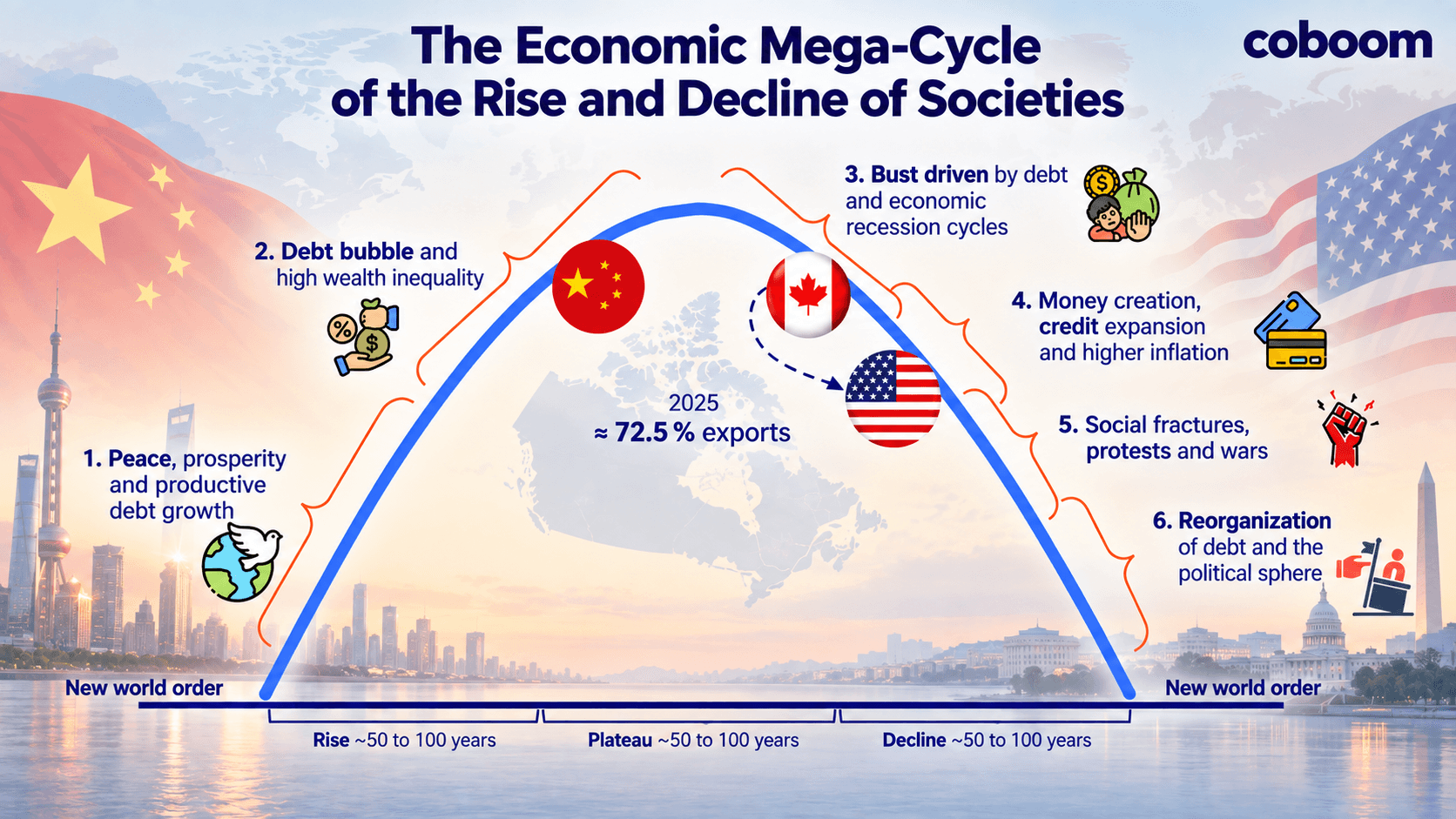
Thinkers such as British historian Arnold Toynbee and American investor Ray Dalio have offered different interpretations of how major powers rise, transform, and decline. Their frameworks may be debated, but they point to something important: today’s instability goes far beyond one administration, one election, or one economic cycle.
What we are experiencing looks more like a period of structural change in which economic, social, environmental, geopolitical, and technological pressures increasingly reinforce one another. These pressures are unlikely to disappear all at once. Waiting for a return to a perfectly stable environment could therefore mean waiting for a very long time.
In this environment, we see two very different responses. One is to reduce exposure, protect what already exists, and wait for conditions to become more predictable. The other is to adjust course, test new business models, reduce dependencies, and open new paths despite the uncertainty.
For us, the question is becoming much more practical: what is preventing us, right now, from making the important decisions that will shape the future of our businesses and organizations?