Quebec has just rolled out two loan programs to help businesses hit by the latest U.S. tariffs. The logic is straightforward: lend companies money to buy time while they adjust their business models, supply chains, and markets. But time is useful only if something actually changes. Nothing guarantees that trade relations with the United States will return to anything resembling the old normal, whether next year or ten years from now.
Washington is increasingly using trade as leverage. New tariffs are hitting steel, aluminum, manufactured goods, semiconductors, and other sectors, leaving Quebec exporters caught in a fight they did not start and have very little power to influence. Many are entering that fight with almost no financial cushion. In 2025, BDC reported that only 14% of Canadian SMEs considered themselves highly profitable, nearly a quarter were barely breaking even, and 12% were losing money.
We would therefore be surprised to see most tariff-hit businesses rushing to borrow even more. Those that do should ask themselves one brutal question: are they borrowing to finance a real transformation, or simply postponing the moment when they have to admit that their business model no longer works?
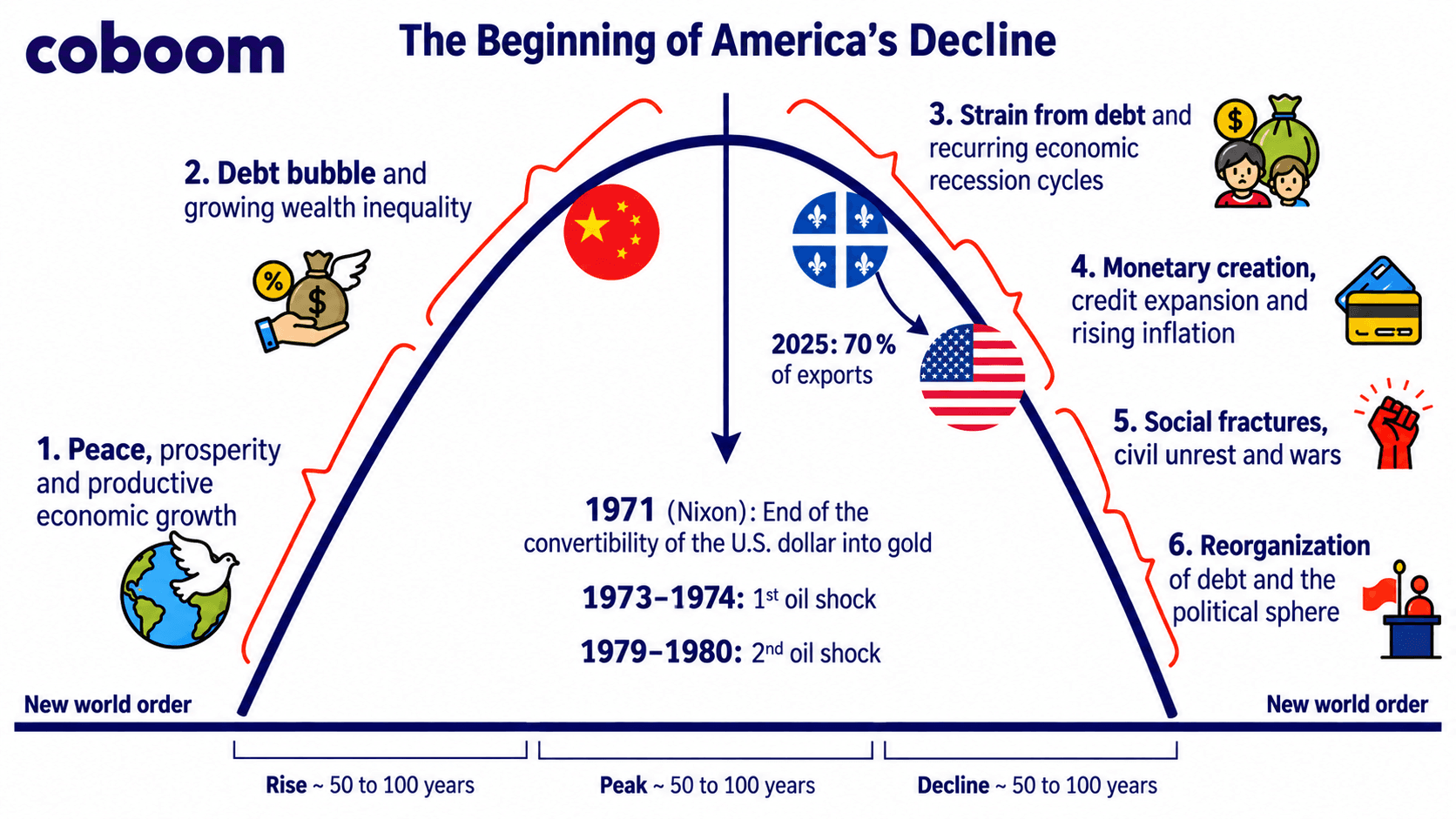
Ray Dalio, billionaire founder of Bridgewater Associates, has spent years documenting the patterns that accompany the decline of great powers: exploding debt, weakening competitiveness, internal tensions, monetary pressure, and increasingly aggressive geopolitical behavior. The United States has now crossed the extraordinary threshold of US$40 trillion in federal debt.
The roots run much deeper. U.S. conventional oil production peaked in 1970, and the oil shocks of 1973 and 1979 exposed just how vulnerable an economy becomes when its energy foundations are shaken. The shale boom later revived U.S. production, but the country’s debt continued to grow to levels that would have been almost unimaginable a generation ago.
With US$40 trillion in debt and trade increasingly weaponized, Quebec businesses should stop building strategies around the hope that Washington will eventually calm down and everything will go back to the way it was. Waiting for the old world to return is no longer a strategy. It is denial financed with borrowed money.
Quebec itself has far less room to keep throwing money at industrial bets that go wrong. Northvolt has become the symbol of that problem: Quebec disbursed C270 million that has been lost and another C$240 million that the government is still trying to recover. That money would look awfully useful today to businesses getting hammered by tariffs.
A loan can buy oxygen. It cannot fix dependence on the U.S. market, weak profitability, an obsolete product mix, or a fragile business model. Companies need to rethink their strategies, reduce critical dependencies, protect cash flow, and decide which activities, resources, products, customers, and markets to maintain, adapt, develop, or abandon.
Some of those decisions will hurt. Shutting down a product line, walking away from a market, dropping an unprofitable customer, or shrinking the company takes far more courage than signing another loan agreement. But a smaller company that is profitable and alive is infinitely better than a larger one kept on life support by debt.
Quebec’s loans can buy time. Borrowing that money simply to wait for “normal” to come back will only finance a slower death. The businesses that survive this period will be the ones that use that borrowed time to transform themselves before the market does it for them.