In two recent posts, we described our economy as a Tower of Babel and a collective Dinner for Schmucks, where we keep running faster to feed a machine that demands ever more on a finite planet. We also pointed out that the word “economy” originally meant the art of managing the household well.
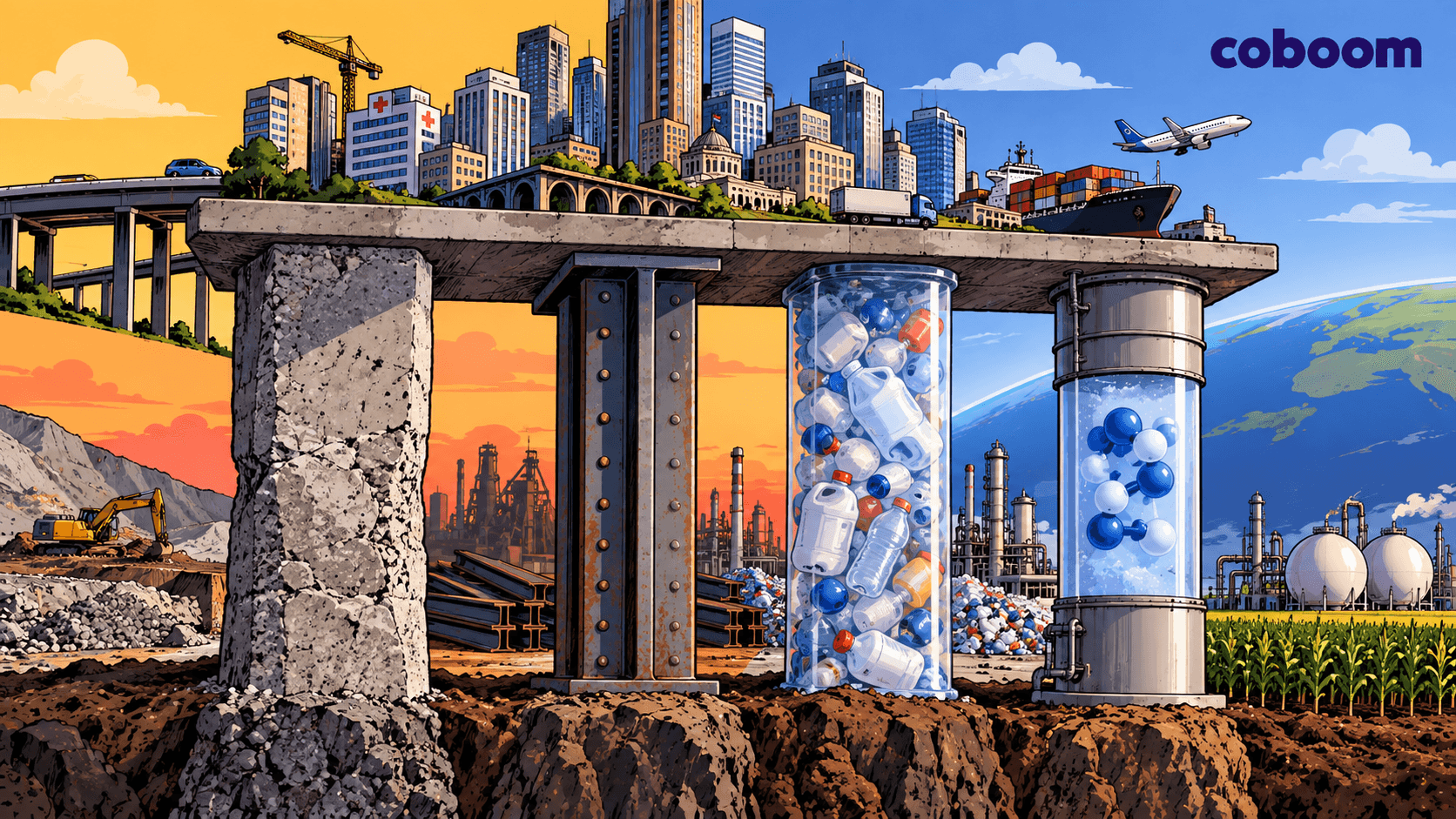
To manage the house properly, we first need to look at its foundations. Vaclav Smil, a world-renowned Canadian scholar, reminds us that modern civilization rests on four material pillars: concrete, steel, plastics, and ammonia.
Concrete forms our buildings, roads, bridges, dams, and much of our public infrastructure. Steel supports those same infrastructures, along with our machinery and transportation systems: cars, trucks, trains, and ships.
Plastics are everywhere in healthcare, food, electronics, and transportation. Ammonia, produced primarily from natural gas, is used to manufacture nitrogen fertilizers that support nearly half of global food production.
These four materials form the physical backbone of our economy. All our financial, digital, and technological sophistication ultimately rests on this material foundation.
Global production of concrete and steel is plateauing. Plastics and ammonia will follow as natural gas, oil, and coal become more expensive, more constrained, and more unstable.
When the material base stops expanding, economic expansion stops with it. We then move from an economy that keeps building more to an economy struggling to maintain, repair, and preserve what it already has.
Arthur Berman, an American petroleum geologist and energy analyst known for his work on the physical limits of the oil industry, describes this dynamic as a race to the bottom. Margins shrink, wages fall behind inflation, quality declines, standards loosen, and geopolitical stability erodes.
In a world contracting in energy and material terms, competition for resources intensifies. China, the United States, and other major powers are already hardening their strategies to secure energy, raw materials, technologies, and supply chains.
We can create debt at will and write billions of lines of code. Concrete, steel, fertilizers, natural resources, and energy remain bound by the constraints of the physical world.
Continuing to promise endless growth while the material foundations weaken is economic denial. Debt can delay the bill, as illustrated by the projected $13.6 billion deficit in Quebec and $78.3 billion deficit in Canada in the 2025–2026 budgets, but physical constraints always impose their terms eventually.
Physics always sends the bill. The longer we wait to adapt our companies, municipalities, and infrastructure to these constraints, the larger that bill becomes.
In Quebec, this reality is already visible in the infrastructure maintenance deficit documented by the Auditor General of Quebec and the Ordre des ingénieurs du Québec. Our deteriorating roads and aging infrastructure already show what happens when a society keeps promising expansion while allowing the foundations of the house to crumble.